Skip to content
Gunter's Fables

Educational kit

Turn the reading of a fable into a learning moment

Whether you’re a parent or a teacher, a simple ritual and age-appropriate questions are all it takes to turn a fable into a real moment of discovery, from age 3 to 18.

Build your reading ritual

Answer four questions: the page assembles the ritual, the questions, and the activity that match your situation.

Who are you?

The ritual is not carried out the same way at home and in class.

Start by experiencing a fable

The kit really comes into its own once the fable has been read. Two stories to start with, free to read online.

The reading ritual

1

Before: set the moment

Set up a calm moment, with no screen and no background noise: at home, a corner of the couch or a bed; in class, a circle or a reading corner. Show the cover, read the title, and let the fable’s question hang in the air for a few seconds before opening the book.

2

During: read aloud

Read aloud, without rushing the pace: at home, a parent or the child themself depending on their age; in class, the teacher or a shared reading with several voices. Let the illustrations breathe, and do not get ahead of the question the story asks.

3

After: let them search

Leave a silence after the last sentence before speaking. Ask the fable’s question aloud and do not give the answer: at home, let the child put their own explanation into words; in class, gather several answers before deciding together.

4

Extend: move into action

End with a concrete outcome, suited to the age: at home, a drawing on display or a conversation at the table that same evening; in class, a group activity or a short presentation. It is this outcome that turns a good reading moment into a lesson that stays.

What’s in the kit

One sheet per fable

For each of the two fables, the essentials: the hook, what it truly teaches, and questions checked against the text, ready to ask with no preparation.

Questions by age group

Two questions per age and per fable, worded to stay answerable from the story itself, from 3 to 18 years old.

A concrete activity

For each fable, a simple thing to do together: drawing, comparing, modeling. A way to extend the reading with hands as well as words.

A 4-step reading ritual

Before, during, after, extend: a warm framework that works just as well at home as in class, with no special materials.

Graduated outcomes

From drawing the animal for the youngest to a mini project inspired by the economic model for high schoolers, a concrete output at every age.

Vocabulary faithful to the collection

The kit reuses the markers already familiar from the collection: Did you know?, Think about it, Do it yourself, and the five intelligences awakened by each fable.

The companion sheets

A complete sheet for every fable: what it teaches, its activity, and the questions to ask for each of the four age groups.

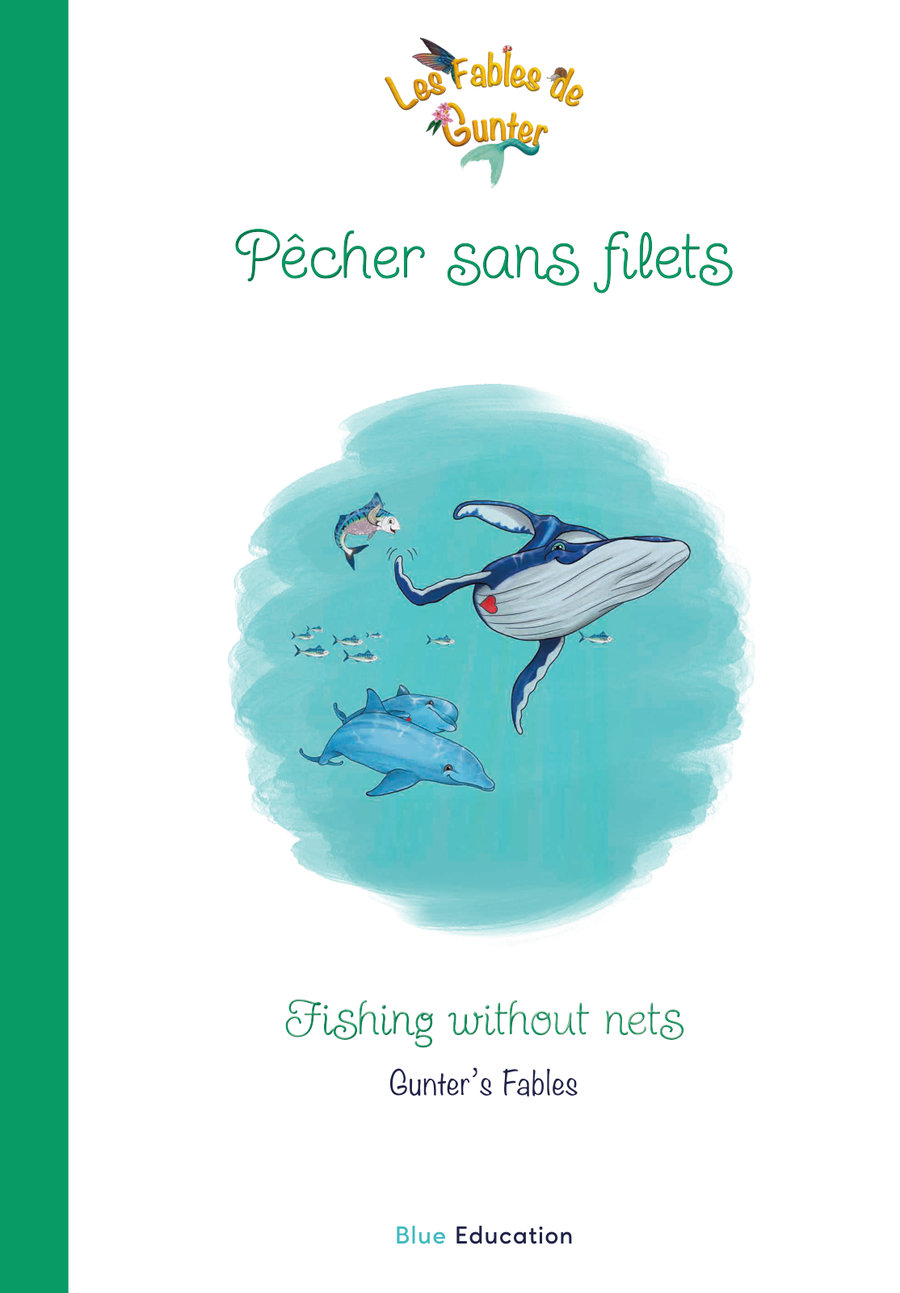
Cover of the fable Fishing Without Nets

Companion sheet

Fishing Without Nets

A whale and a baby dolphin show that you can feed yourself from the sea without exhausting the sea.

What this fable teaches

  • That fishing techniques inspired by humpback whales exist, replacing nets with a bubble net.
  • That protecting mother fish guarantees the balance and survival of species over time.
  • That an idea observed in nature can become a method actually used by fishing communities.
  • That protecting a resource and continuing to live from it are not two opposing goals.

The activity to do together

Draw or model with modeling clay the “bubble net” formed by the whale and the dolphin, to visualize how a circle of bubbles can replace a real net.

Inside illustration of the fable Fishing Without Nets

Questions to ask, age by age

3 to 6 years old · Preschool

  • How do the whale and the dolphin manage to fish without a net?
  • Why is it important to leave the mother fish in peace?

What to remember · Parent

A drawing of the fable’s animal, displayed somewhere in the house.

What to remember · Teacher

A collective drawing of the animal, displayed in class.

Subjects: Science awareness, Visual arts, Oral language

6 to 11 years old · Primary school

  • What is the bubble net, and what is it used for while fishing?
  • Why can overfishing endanger life in the sea?

What to remember · Parent

A short text or a diagram explaining the phenomenon in the child’s own words.

What to remember · Teacher

A labeled diagram of the phenomenon, in the science notebook.

Subjects: Life and earth sciences, Geography, Language arts

11 to 15 years old · Middle school

  • How does this fishing method change the way non-target fish are treated?
  • What economic advantages can this kind of method bring to fishermen, beyond the environmental ones?

What to remember · Parent

A letter or a short presentation taking a stance on the fable’s subject.

What to remember · Teacher

A short oral or written presentation connecting the fable to a real issue.

Subjects: Life and earth sciences, Economics, Civic education

15 to 18 years old · High school

  • How could a method inspired by whale behavior become an innovation usable by professional fishermen?
  • What does this approach change in the balance between economic profitability and preserving a natural resource?

What to remember · Parent

A mini project, even a rough sketch, inspired by the fable’s economic model.

What to remember · Teacher

A mini project or a business plan sketch inspired by the fable’s economic model.

Subjects: Economics, Economic and social sciences, Civic education, Entrepreneurship

Read the fable

Choose your situation, the link adapts.

You have the book

Nothing to prepare: open the book, the sheet above gives the questions and the activity that go with it. The other titles in the collection are found in the box sets.

Read the fable online
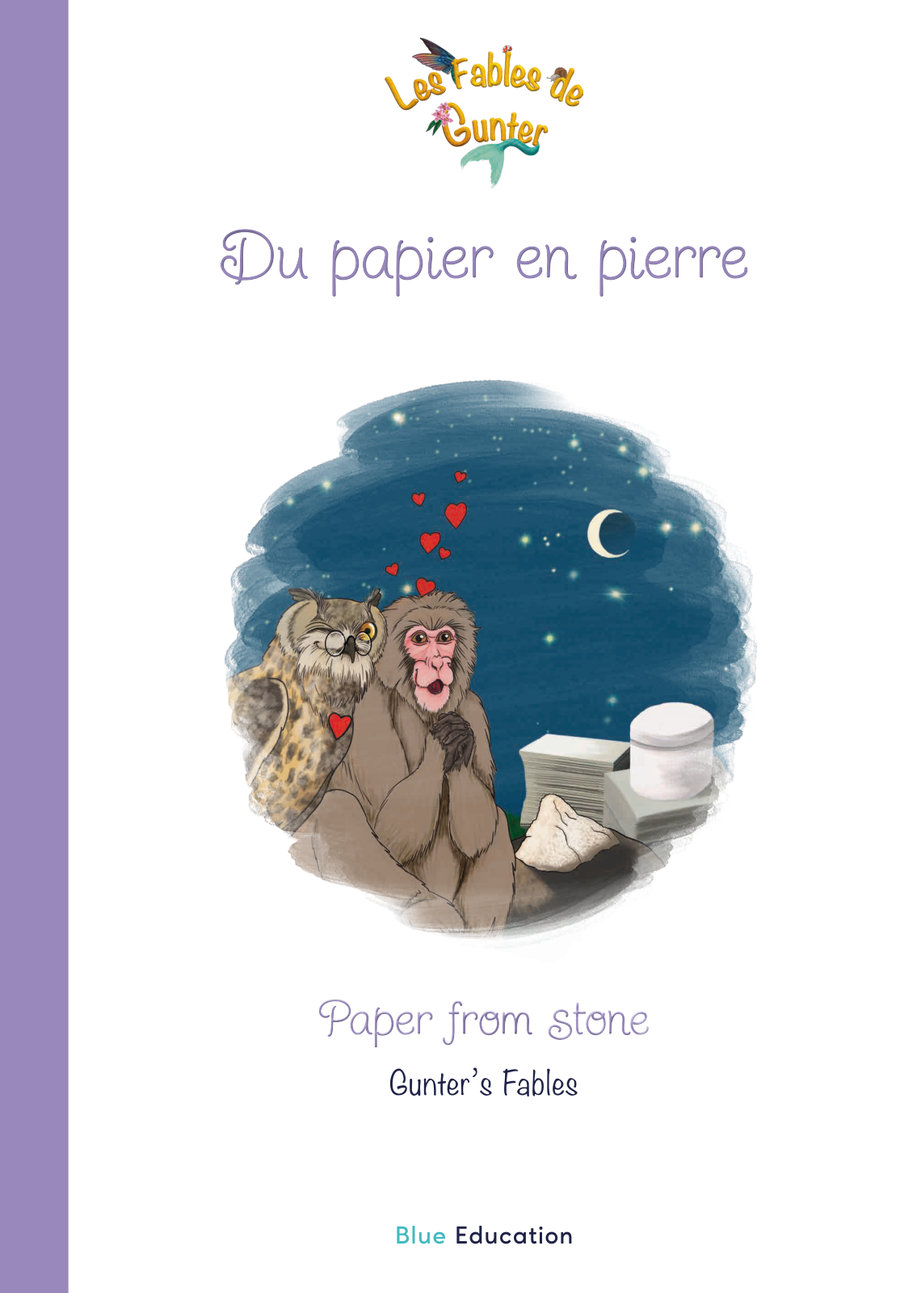
Cover of the fable Paper from Stone

Companion sheet

Paper from Stone

A monkey and an owl discover that paper can be made without cutting down a single tree, and without using a drop of water.

What this fable teaches

  • That stone paper is made from rock dust and recycled plastic, without water or wood.
  • That this technology frees up farmland otherwise used to grow trees for paper.
  • That making things differently can also create new jobs, not just save resources.
  • That stone paper can be recycled endlessly, unlike traditional paper.

The activity to do together

Compare the feel of traditional paper and a sheet of stone paper, or failing that a photo of its texture, and list its qualities together: soft, waterproof, grease-resistant, endlessly recyclable.

Inside illustration of the fable Paper from Stone

Questions to ask, age by age

3 to 6 years old · Preschool

  • What do the monkey and the owl make their paper from, instead of wood?
  • Why does this paper not need any trees to be cut down?

What to remember · Parent

A drawing of the fable’s animal, displayed somewhere in the house.

What to remember · Teacher

A collective drawing of the animal, displayed in class.

Subjects: Science awareness, Visual arts, Oral language

6 to 11 years old · Primary school

  • What is stone paper made of: how much stone, how much recycled plastic?
  • Why is saving water so important when making paper?

What to remember · Parent

A short text or a diagram explaining the phenomenon in the child’s own words.

What to remember · Teacher

A labeled diagram of the phenomenon, in the science notebook.

Subjects: Life and earth sciences, Geography, Language arts

11 to 15 years old · Middle school

  • How does making stone paper emit less CO2 than making regular plastic?
  • What farmland does this new paper free up, and why does that matter?

What to remember · Parent

A letter or a short presentation taking a stance on the fable’s subject.

What to remember · Teacher

A short oral or written presentation connecting the fable to a real issue.

Subjects: Life and earth sciences, Economics, Civic education

15 to 18 years old · High school

  • What was William Liang’s journey to get an idea once thought impossible accepted?
  • How does being able to recycle stone paper endlessly change the business model of a paper factory?

What to remember · Parent

A mini project, even a rough sketch, inspired by the fable’s economic model.

What to remember · Teacher

A mini project or a business plan sketch inspired by the fable’s economic model.

Subjects: Economics, Economic and social sciences, Civic education, Entrepreneurship

Read the fable

Choose your situation, the link adapts.

You have the book

Nothing to prepare: open the book, the sheet above gives the questions and the activity that go with it. The other titles in the collection are found in the box sets.

Read the fable online

Sneak peek: the fable told step by step

An interactive reader is in the works, to experience a fable step by step online. Leave your email to get early access and receive news about the educational kit.

Frequently asked questions

What if my child loses interest during the reading?

That is normal, especially with younger children: shorten it without guilt, save the fable’s question for later, and come back to it another evening. What matters is the pleasure of the shared moment, not reading it all in one go.

What if the class laughs or gets restless during the reading?

A bit of restlessness around a whale or a monkey is not a failure, it shows the story is landing. Let the laughter settle before continuing, and use it as a starting point for discussion rather than a problem to shut down.

Do you need to be a scientist to lead this ritual?

No. Each fable and each sheet in the kit already give the vocabulary and the facts needed. The adult’s role is not to know everything, but to ask the question and let the child search for their own answer.

What if the child asks a question I don’t have the answer to?

That is a great opportunity to learn together: simply say you don’t know, and offer to look for the answer together. That honesty is worth more than a made-up answer, and it shows that curiosity keeps going after the last page.

Which fable should we start with?

Fishing Without Nets and Paper from Stone are both good entry points: the first is close to children, with animals and the sea, the second touches an everyday object, paper. Start with whichever speaks most to the child or the class in front of you.

Can the ritual be done as a family with several ages at once?

Yes, that is even one of the collection’s strengths: read the same fable to everyone, then ask each person the question suited to their age. The older ones often enjoy hearing the younger ones’ answers, and the other way around.