The thinkers who inspire Gunter’s Fables
John Dewey: Pioneer of Progressive and Sustainable Education
Discover how John Dewey’s pragmatic approach inspires environmental education and sustainable action in children.
By Axel Rihs · Published on 27 March 2025 · Updated on 16 October 2025
Gunter Pauli and his pedagogical inspirations
Gunter Pauli, creator of Gunter’s Fables, drew inspiration from the visionary work of Paulo Freire, notably his critical pedagogy centered on social and environmental justice. However, Pauli also explored the contributions of many other influential educators, weaving their ideas into his educational stories for children. As a result, Gunter’s Fables resonate with a range of modern pedagogical approaches, such as those of Maria Montessori, Rudolf Steiner, John Dewey, Humberto Maturana, Jean Piaget, and Fritjof Capra, offering an educational richness adaptable to different contexts.
Introduction
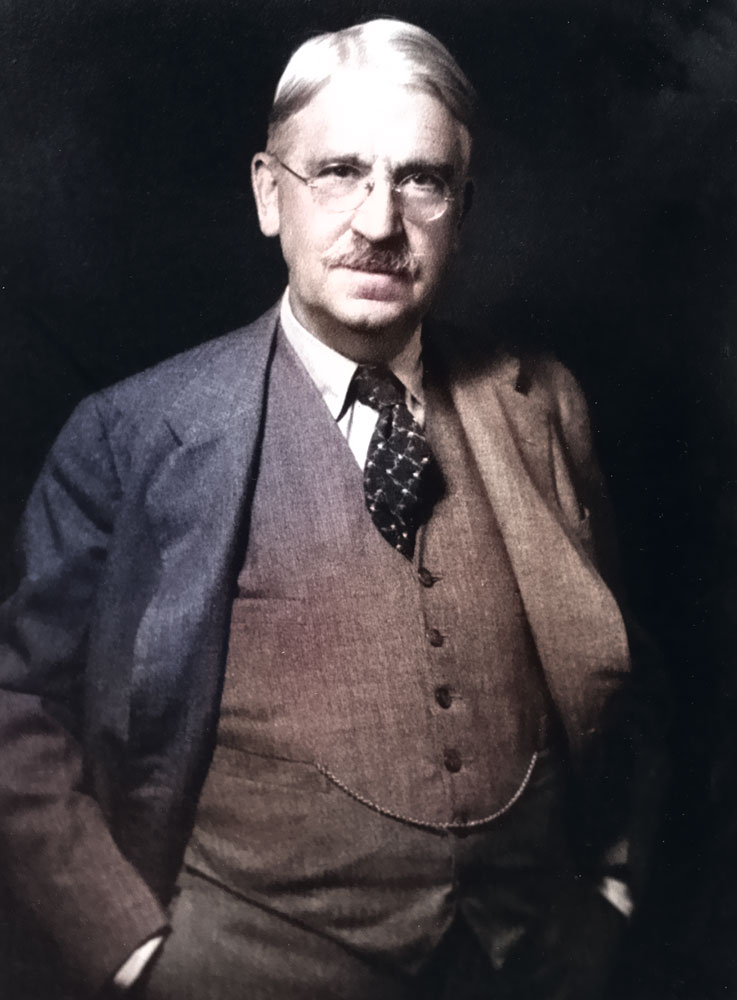
John Dewey, an American philosopher and educator, is often regarded as a pioneer of progressive education. Born on 20 October 1859 and died on 1 June 1952, he revolutionized the way we think about learning by emphasizing hands-on experience and students’ active participation. His ideas, rooted in pragmatism, have had a lasting influence on education worldwide and are especially relevant to environmental education, a key theme of Gunter’s Fables. This article explores his life, his educational philosophy, and its connection to sustainability, showing how his theories can inspire children to become agents of change.
Early Life and Career
John Dewey was born in the small town of Burlington, Vermont, into a modest family. After graduating from the University of Vermont in 1879, he went on to study at Johns Hopkins University, earning a doctorate in philosophy in 1884. His academic career began at the University of Michigan, but it was at the University of Chicago, starting in 1894, that he made his mark by founding the Laboratory School. This experimental institution allowed Dewey to test his educational theories, placing students at the center of learning. In 1904, he joined Columbia University in New York, where he taught until his retirement in 1930. His major works, such as Democracy and Education (1916) and Experience and Nature (1925), cemented his reputation as an influential thinker in philosophy, psychology, and social reform.
John Dewey’s Educational Philosophy
Dewey’s pedagogy is rooted in pragmatism, a philosophy that values practical results and experience as sources of knowledge. His core principles include:
- Experience-based learning: Dewey believed education should engage students in concrete activities, rather than being limited to passive transmission of knowledge.
- Problem-solving and critical thinking: He encouraged students to ask questions, experiment, and reflect in order to build their intellectual skills.
- Integration of subjects: Dewey advocated for a holistic curriculum where disciplines are interconnected, making learning relevant to real life.
- Democracy in education: He saw schools as microcosms of society, where students learn to collaborate and take part in democratic processes.
These ideas gave rise to the progressive education movement, which continues to shape modern education systems by placing the student at the center of their own learning.
Connection to Environmental Education
Although Dewey never explicitly addressed environmental education, his approach offers a powerful framework for teaching sustainability:
- Learning from nature: By favoring direct experience, Dewey’s approach supports activities such as observing wildlife, gardening, or outdoor exploration, helping children understand ecosystems.
- A pragmatic approach to sustainability: His problem-solving method can be applied to concrete environmental challenges, such as waste management or water conservation.
- Interdisciplinary connections: Environmental education, which combines science, ethics, and social action, reflects his vision of integrated learning.
These elements echo the goals of Gunter’s Fables, which seek to raise children’s awareness of ecological issues while encouraging them to act for the planet.
Practical Implementation in Education
Educators can apply Dewey’s ideas in concrete ways:
- Outdoor learning: Holding classes in parks or gardens to connect students with their natural environment.
- Project-based learning: Launching initiatives such as a school compost or a study of local air quality, fostering research and action.
- Community engagement: Involving students in local projects, such as clean-up campaigns or tree planting, to build a sense of collective responsibility.
These practices make education lively and relevant, preparing children to face environmental challenges with confidence and creativity.
Impact and Legacy
John Dewey’s influence on education is immense. His ideas have inspired educational reforms around the world, emphasizing a student-centered, experimental, and democratic approach. He also contributed to debates on social justice and democracy, advocating for a society in which education plays a central role in collective progress. In the context of environmental education, his legacy offers a model for designing programs that not only inform but also engage students in concrete action for sustainability. Today, institutions such as the John Dewey Society keep his ideas alive, underscoring their continued relevance.
Conclusion
John Dewey redefined education as an active, collaborative adventure, where experience and critical thinking prepare students to shape their world. His philosophy, though developed over a century ago, remains strikingly relevant to modern environmental education. In resonance with Gunter’s Fables, which aim to inspire children to become agents of change for the planet, Dewey’s ideas offer valuable tools for parents and educators seeking to cultivate ecological awareness and sustainable action in younger generations.
John Dewey and Gunter’s Fables
In resonance with Gunter’s Fables, which aim to inspire children to become agents of change for the planet, Dewey’s ideas offer valuable tools for parents and educators seeking to cultivate ecological awareness and sustainable action in younger generations.
Discover the fables